

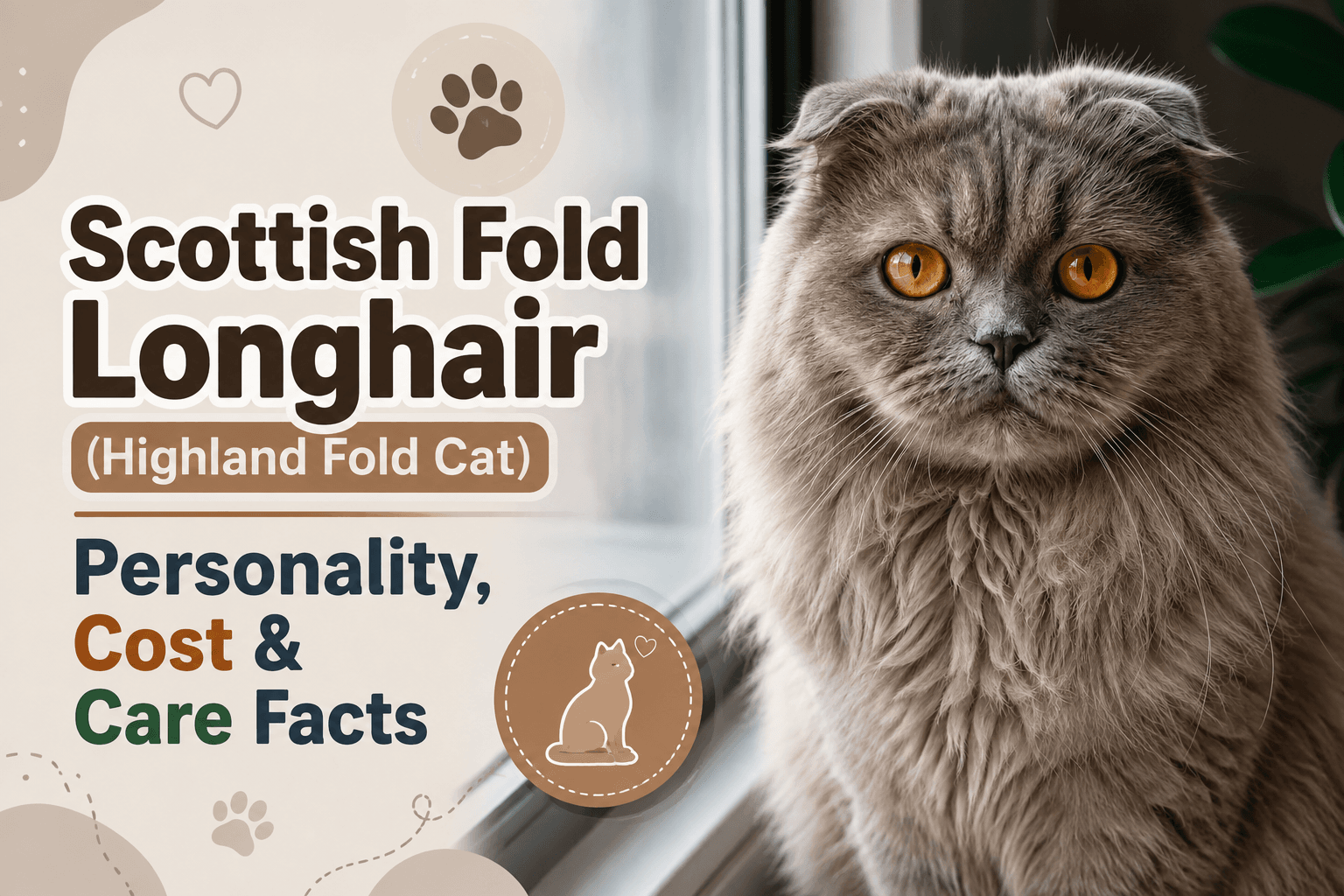
If you’ve come across a fluffy, owl-faced cat with folded ears and a plush coat, you may have seen a Scottish Fold Longhair though depending on where you looked, it might have been labeled a Highland Fold instead. Both names describe the exact same cat, and the confusion around naming is one of the first things every new owner runs into.
In this guide, we’ll break down what a Scottish Fold Longhair actually is, how it differs from its short-haired Scottish Fold, what to expect in terms of temperament and health, and how much one typically costs depending on where you live.
What Is a Scottish Fold Longhair?
A Scottish Fold Longhair is simply the long-haired version of the Scottish Fold a medium-sized cat known for its rounded face, large round eyes, and ears that fold forward, giving it a distinctive owl-like look. The only meaningful difference between a Scottish Fold Longhair and a standard Scottish Fold is coat length; everything else about the breed, including temperament, body shape, and health background, is shared between the two.
Scottish Fold Longhair vs Highland Fold Same Breed, Different Names
This is where most of the confusion comes from. The International Cat Association (TICA) refers to the long-haired variety as the Highland Fold, while the Cat Fanciers’ Association (CFA) simply calls it Scottish Fold Longhair. Some smaller registries even use older names like Longhair Fold or Coupari. None of these names describe a different cat they’re all pointing to the same long-haired Fold.
TICA and CFA Naming Differences
- TICA: Highland Fold (folded ears) / Highland Straight (straight ears)
- CFA: Scottish Fold Longhair (both ear types grouped under Scottish Fold)
- GCCF (UK): Neither variety is officially recognized, due to long-standing welfare concerns tied to the ear-fold gene
Knowing this naming split matters if you’re searching for breeders, cat shows, or registration papers the same cat may be listed under either name depending on the organization. You can view the official breed standard directly on TICA’s Scottish Fold Longhair page.
Origin & History of the Scottish Fold Longhair
Susie The Original Scottish Fold (Scotland, 1961)
Every Scottish Fold alive today, longhaired or not, traces back to a single barn cat named Susie, discovered on a farm near Coupar Angus, Scotland, in 1961. Susie had a natural genetic mutation that caused her ears to fold forward. A local shepherd, William Ross, noticed the unusual trait and began a breeding program using Susie’s kittens.
How the Longhair Gene Entered the Breed
Early breeders crossed Fold cats with British Shorthairs, American Shorthairs, and notably Persians, in an effort to strengthen the round, plush look the breed is known for. This is how the recessive longhair gene entered the gene pool. Because the gene is recessive, longhaired kittens only appear when both parent cats carry the gene, which is why Scottish Fold Longhairs turned up occasionally in litters rather than being bred intentionally at first.
Recognition Timeline (CFA, TICA, GCCF Status)
The longhaired variety was initially seen as less desirable and was often placed as a pet rather than shown. Over time, breeders began to appreciate the coat, and CFA formally recognized the longhaired variety in the mid-1980s under the Scottish Fold name. TICA later gave it a distinct identity as the Highland Fold. The GCCF in the UK, by contrast, has never recognized the breed at all, largely due to concerns about the health effects of the ear-fold mutation. You can read more on the breed’s documented genetic background on Wikipedia’s Scottish Fold entry.
Scottish Fold Longhair vs Standard Scottish Fold: Key Differences
Coat Length Comparison
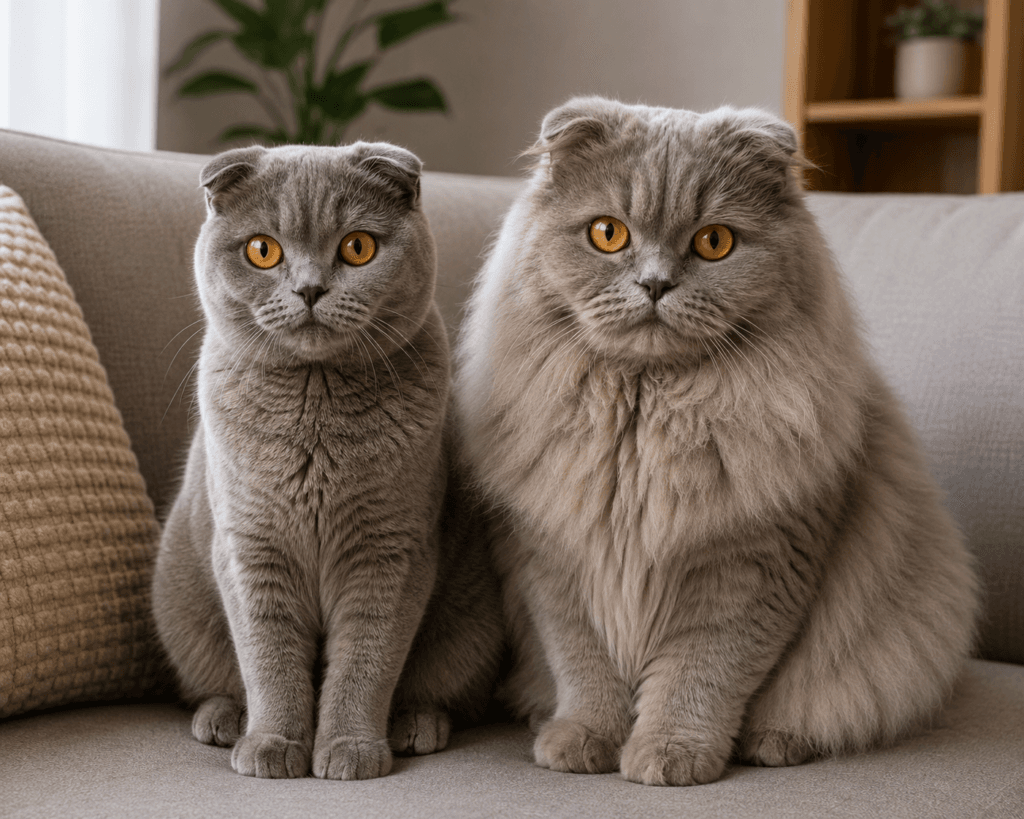
The standard Scottish Fold has a short, dense coat, while the Scottish Fold Longhair has a semi-long coat with noticeable tufting around the ears, toes, and tail.
Grooming Needs Comparison
Despite the longer coat, the Scottish Fold Longhair doesn’t require dramatically more grooming than its short-haired counterpart. The coat lacks the dense undercoat seen in breeds like the Persian, which means it’s less prone to matting and easier to maintain with a weekly combing session.
Shared Traits (Ears, Temperament, Health Risks)
Ear-fold structure, body shape, personality, and known health risks are identical between the two coat types. The only cats that don’t display the trademark folded ears regardless of coat length are known as Scottish Straights or Highland Straights.
Quick Comparison Table
| Feature | Scottish Fold (Shorthair) | Scottish Fold Longhair (Highland Fold) |
|---|---|---|
| Coat length | Short, dense | Semi-long, tufted |
| Grooming | Weekly brushing | Weekly combing |
| Ear fold | Present (dominant gene) | Present (dominant gene) |
| Temperament | Calm, affectionate | Calm, affectionate |
| Rarity | More common | Rarer (recessive gene) |
| CFA name | Scottish Fold | Scottish Fold Longhair |
| TICA name | Scottish Fold | Highland Fold |
Scottish Fold Longhair Appearance & Coat Colors
Body Shape, Face & Ear Fold Structure
The Scottish Fold Longhair has a rounded head, wide-set round eyes, a short nose, and a compact, medium-sized body with rounded paws. The ears fold forward and down, sitting close to the skull, which contributes to the breed’s signature owl or teddy bear expression.
Coat Texture (Semi-Long Hair Explained)
Unlike Persian-type coats, the Scottish Fold Longhair’s fur is soft but not overly dense, with the longest hair typically appearing around the neck ruff, ears, legs, and tail.
Popular Color Variants
The Scottish Fold Longhair comes in nearly every color and pattern accepted in the breed standard, including solid, tabby, tortoiseshell, and bi-color combinations.
Grey Scottish Fold Longhair
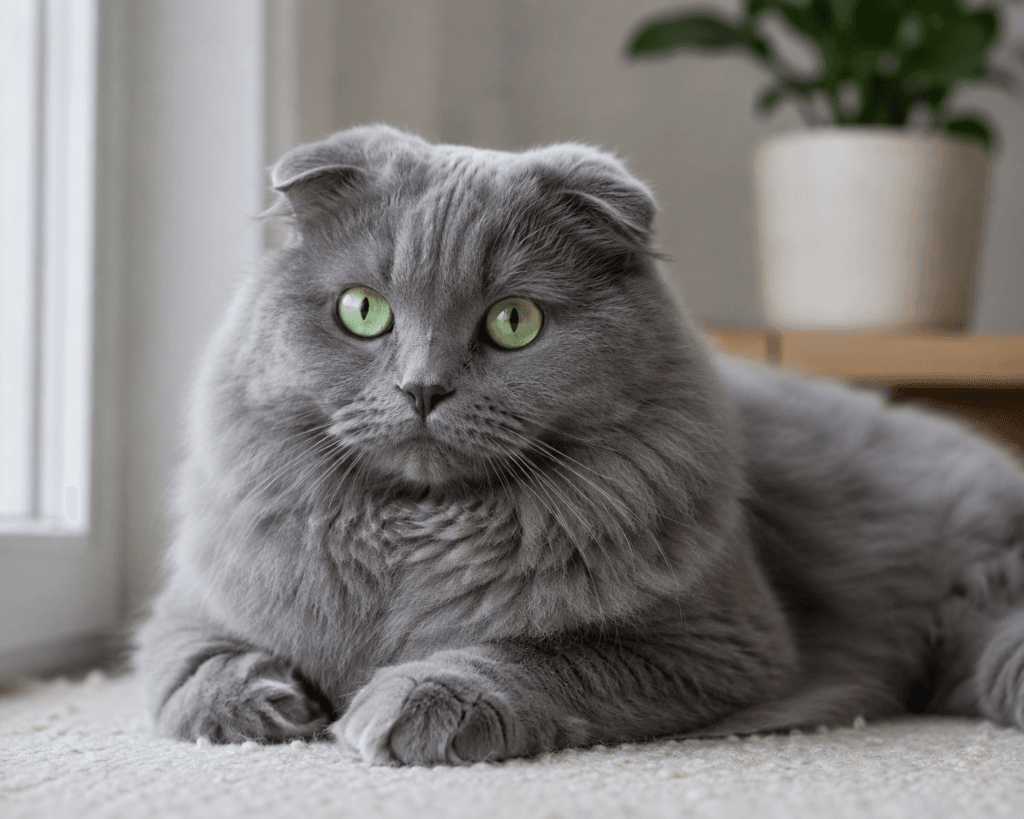
A solid or blue-grey coat is one of the most commonly searched-for color variations, prized for its soft, uniform tone.
Golden Scottish Fold Longhair
Golden and cream-toned Folds have a warm, honey-like coat that’s especially popular in kitten photos and social media content.
Orange Scottish Fold Longhair
Orange (red) tabby patterns are common in both coat lengths and tend to be more frequently male due to the genetics behind the color.
White Scottish Fold Longhair
Solid white is one of the rarer, more striking color variants Susie, the original Scottish Fold, was herself a white longhaired cat.
Scottish Fold Longhair Straight-Eared Variant
Not every kitten in a Fold litter is born with folded ears. Those with straight ears are called Scottish Straights (or Highland Straights, in long-haired form) and share the same body type and temperament, just without the folded-ear trait. For a full breakdown of every Scottish variant, see our guide to all Scottish cat breeds.
Scottish Fold Longhair Temperament & Personality
Affection Level (Do They Like Cuddling?)
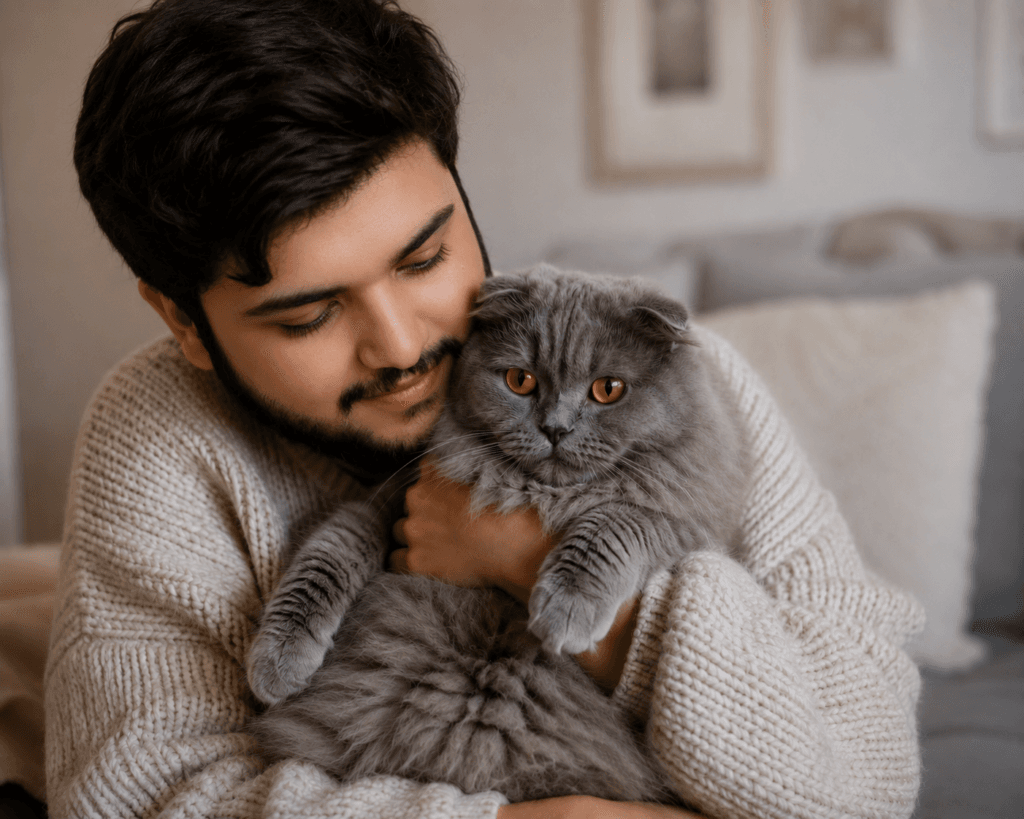
Yes Scottish Fold Longhairs are widely known for being affectionate and people-oriented. They tend to follow their owners from room to room rather than hiding away, and most enjoy being held and cuddled, though individual personality always plays a role. Hill’s Pet also notes the breed’s easygoing, family-friendly nature as one of its defining traits.
Behavior Around Children & Other Pets
This breed is generally easygoing around children and gets along well with other cats and cat-friendly dogs when introduced properly, making it a solid choice for multi-pet households.
Intelligence & Trainability
Scottish Fold Longhairs are intelligent and curious, and many can learn simple tricks or routines through positive reinforcement, though like most cats training happens on their terms rather than yours. If you’re bringing home a kitten, our Scottish Fold kitten behavior and training guide covers the first year in detail.
Is the Scottish Fold Longhair a Rare Breed?
Why the Recessive Longhair Gene Makes Them Rarer
Yes, the Scottish Fold Longhair is rarer than the standard short-haired Scottish Fold. Because the longhair gene is recessive, both parent cats need to carry it for longhaired kittens to appear, which naturally limits how often they show up in litters compared to the short-haired variety.
Availability by Country (USA, UK, Australia, Japan)
- USA: Available through CFA-registered breeders; relatively easier to find than in other countries
- UK: Not recognized by GCCF; breeding is discouraged and, in some cases, restricted on welfare grounds
- Australia: Available but less common than shorthaired Folds; import restrictions can affect availability
- Japan: Scottish Folds (short-haired) are extremely popular, but the longhaired variety remains a niche find even there
Health Considerations for Scottish Fold Longhair Cats
Osteochondrodysplasia (Joint & Cartilage Condition) Explained
The same gene responsible for the folded ears is linked to a condition called osteochondrodysplasia, which affects cartilage and bone development throughout the body. This can lead to joint stiffness or discomfort, particularly around the tail, ankles, and knees, and is a key reason some registries and countries restrict breeding of folded-ear cats.
Common Negatives Owners Should Know
Beyond the joint condition, prospective owners should be aware that this breed may require more frequent vet monitoring than average, and ethical sourcing from a reputable breeder matters more here than in many other breeds.
Recommended Vet Checkups & Screening
Routine X-rays and mobility assessments, especially in the first two years of life, can help catch early signs of joint issues before they progress.
When to See a Veterinarian
Any signs of limping, reluctance to jump, a stiff or thickened tail, or difficulty grooming themselves should prompt a vet visit as soon as possible.
Scottish Fold Longhair Grooming & Lifespan
Weekly Combing Routine
A weekly combing session is typically enough to keep the coat free of tangles, since the Scottish Fold Longhair lacks the heavy undercoat that makes some longhaired breeds harder to maintain. For step-by-step brushing and bathing routines, see our full Scottish Fold care and grooming guide.
Shedding Levels (Seasonal Changes)
Shedding is moderate year-round with a heavier seasonal shed in spring and fall, which is when extra brushing helps the most.
Average Lifespan & Life Stages
Scottish Fold Longhairs typically live between 11 and 14 years with proper care, regular vet checkups, and a balanced diet suited to their joint health needs. A joint-friendly diet plays a real role here our complete Scottish Fold diet guide covers exactly what to feed at each life stage.
How Much Does a Scottish Fold Longhair Cost?
Price by Country
USA Price Range
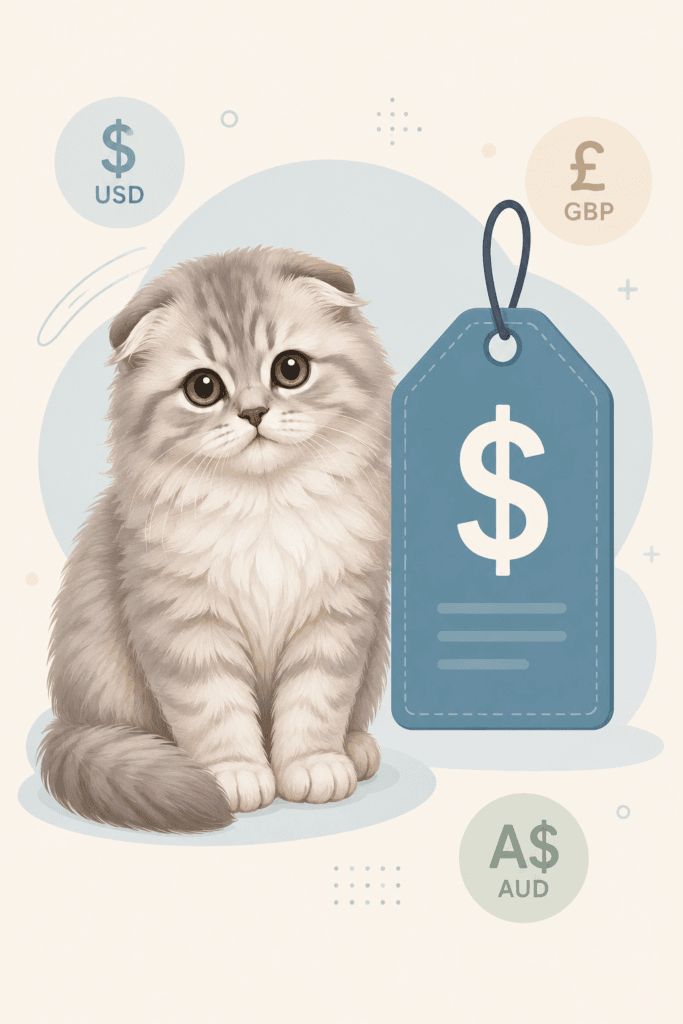
Kittens from registered breeders generally range from $800 to $2,500, with rarer colors or show-quality lines going higher.
UK Price Range
Due to limited recognition and breeding restrictions, prices in the UK can range widely, often between £600 and £1,800, when available through private or overseas breeders.
Australia Price Range
Expect to pay roughly AUD 1,200 to AUD 3,000, with import costs sometimes factored in given lower local availability.
What Affects the Price (Pedigree, Color, Breeder Reputation)
Price is influenced by coat color rarity, pedigree and show lineage, health testing and screening documentation, and the overall reputation of the breeder cats from health-tested, registered lines typically cost more but come with lower long-term health risk.
Where to Find Scottish Fold Longhair Kittens for Sale
How to Identify an Ethical Breeder
A responsible breeder will provide health screening records, allow you to meet the kitten’s parents, and be transparent about the joint-health risks tied to the breed rather than downplaying them.
Red Flags to Avoid (Kitten Mills, Unregistered Sellers)
Be cautious of sellers who can’t provide registration papers, refuse health documentation, or offer multiple breeds and colors on demand, which is often a sign of a high-volume breeding operation rather than a dedicated cattery.
Adoption & Rescue Alternative
Because Scottish Folds and their longhaired variety are sometimes surrendered by owners unprepared for their health needs, checking breed-specific rescues or shelters is worth doing before buying from a breeder. If you do bring one home, our beginner’s care guide is a good next stop for setting up your home correctly.
FAQs
What is the difference between the Scottish Fold and the Highland Fold?
There’s no difference in breed only in coat length and naming convention. The Highland Fold (TICA) and Scottish Fold Longhair (CFA) both refer to the long-haired variety of the same breed.
Can Scottish Folds be long-haired?
Yes. When both parent cats carry the recessive longhair gene, kittens can be born with a semi-long coat, known as a Scottish Fold Longhair or Highland Fold.
How much does a Scottish Fold cost?
Prices generally range from $800 to $2,500 in the US, with variations by country, color, and breeder reputation.
Do Scottish Folds like to be cuddled?
Most do. The breed is known for being affectionate and enjoys close contact with its owners, though individual personalities vary.
What are the negatives of Scottish Folds?
The primary concern is a genetic joint and cartilage condition linked to the ear-fold gene, which is why responsible breeding and regular veterinary checkups are especially important for this breed.
Conclusion
Is a Scottish Fold Longhair Right for You?
If you’re looking for an affectionate, low-maintenance-coat companion with a distinctive look, the Scottish Fold Longhair checks a lot of boxes as long as you’re prepared for the breed’s known health considerations and choose a responsible source for your kitten.